Frankincense and myrrh: Egypt's real aromatics
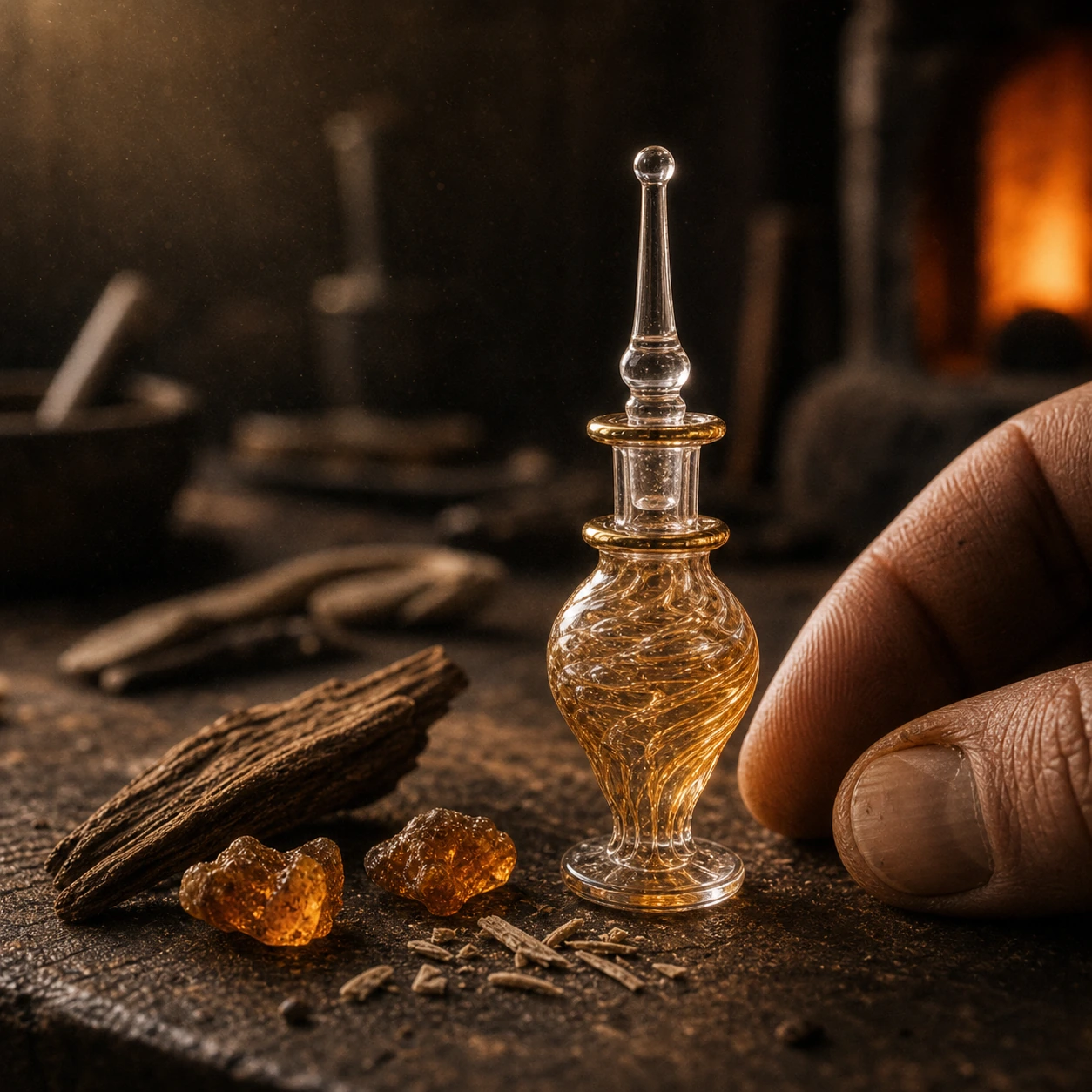
Frankincense and myrrh are so famous that they can start to sound decorative, like old words placed on a label to make a scent feel expensive. In Egypt, they were much more concrete than that. They were plant resins. They came from specific trees. They moved through trade routes. They were burned, mixed, offered, stored and written about.
Both materials begin as gum resin. The bark of a tree is cut or naturally wounded, and the tree releases a fragrant substance that hardens into tears or lumps. Frankincense comes from Boswellia trees. Myrrh comes from Commiphora trees. Neither was simply lying around in the Nile Valley. Egypt had to import these materials from regions to the south and east, especially areas linked in Egyptian records with Punt and the Red Sea world.
That import cost mattered. A rare aromatic is not only a smell. It is proof of access. It says a ruler can send ships, command labor, make offerings and bring distant goods into the temple economy. It also says a household or workshop can afford something more durable and more complex than local flowers alone.
The difference between the two
Frankincense is often brighter, cleaner and more luminous when burned. It can smell citrus-like, mineral, piney, smoky or honeyed depending on the grade and source. In ritual, its smoke makes sense immediately. It rises. It clears the air. It turns a room into a place of ceremony.
Myrrh is heavier. It can smell bitter, warm, medicinal, leathery, dusty, resinous and slightly sweet. It has depth rather than sparkle. In perfume oil, myrrh behaves like a base note. It grips. It gives the scent weight. It can make florals feel older and woods feel darker.
Ancient Egyptian perfume was not arranged in modern top, heart and base-note language, but the materials still behaved physically. A resin that lasts and clings will carry a scent differently from a flower that fades quickly.
Why temples needed resins
Temples were not quiet museums. They were active ritual spaces. Statues were washed, clothed, anointed and offered food, drink and incense. Scent was part of making a space fit for the divine. Burning incense was not a nice extra. It was a material act of purification and offering.
Frankincense and myrrh were suited to that world. They could be stored. They could travel. They could be weighed, counted and given. They could be burned in a controlled way. They could also be blended into more complex preparations, including incense mixtures such as kyphi.
The trade story
The famous expedition of Hatshepsut to Punt shows how seriously Egypt took aromatic materials. Reliefs from her mortuary temple at Deir el-Bahri show the journey as a royal success, with foreign goods and trees brought back to Egypt. Punt is still debated by scholars, but the broad picture is clear enough: Egypt looked beyond its own borders for incense, myrrh, exotic woods and other valued goods.
This is why frankincense and myrrh should not be treated as generic “ancient” notes. They point to geography. They point to labor. They point to ships, harbors, caravans, temples and royal display.
What to look for in perfume oil
In a modern oil, frankincense can make a blend feel lifted without making it sharp. Myrrh can make it feel warm and close without making it sugary. Together, they create a dry, resinous backbone that feels more Egyptian than a loud synthetic sweetness.
The honest version is simple: we cannot bottle one exact scent from an unnamed temple and claim it is unchanged from antiquity. But we can work with the documented materials that Egypt valued. Frankincense and myrrh are two of the strongest links between historical evidence and modern scent.
They are not there for decoration. They are the bones of the old perfume world.