Mendesian perfume and Cleopatra's Egypt
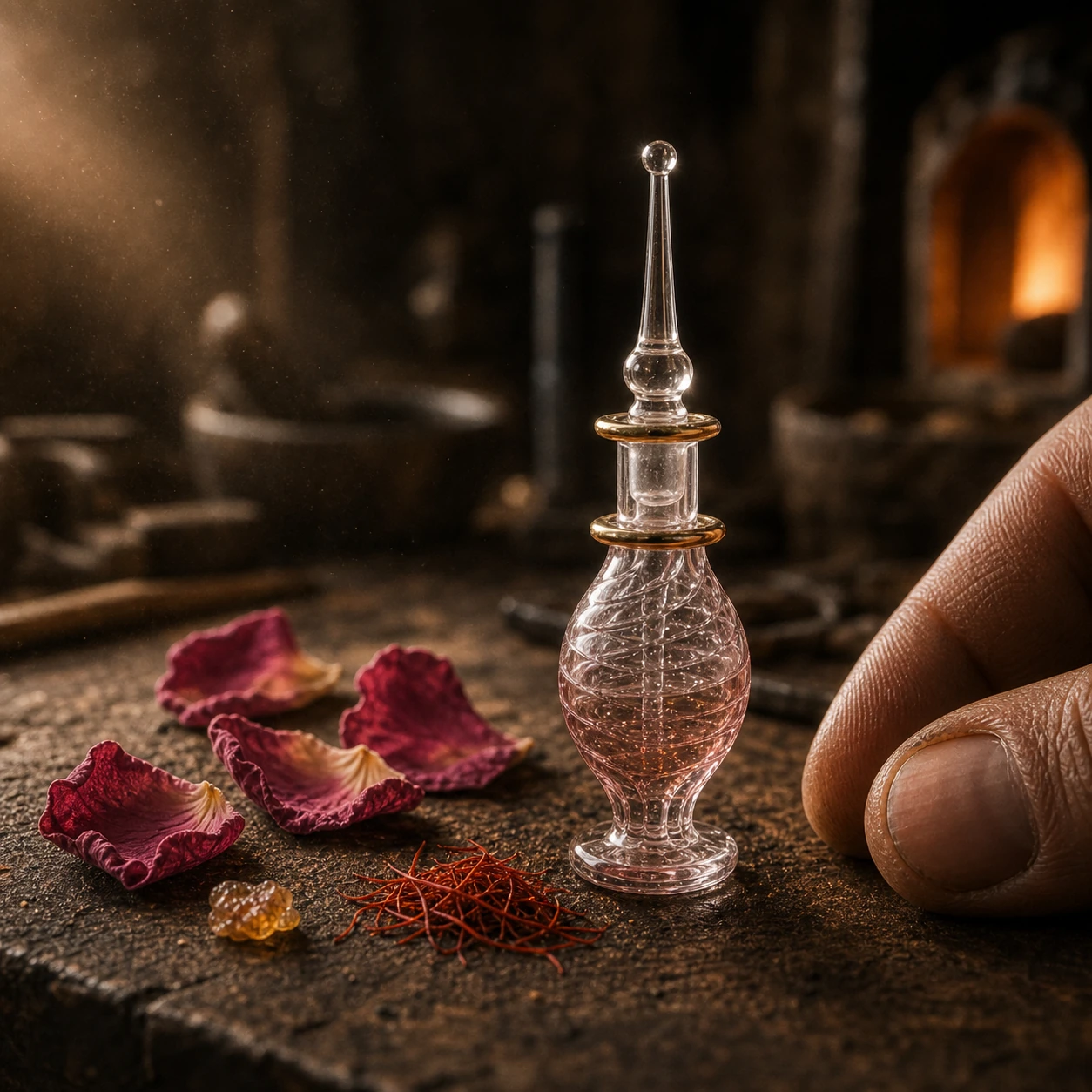
Cleopatra attracts bad perfume history. Her name is so famous that almost any ancient Egyptian scent can be sold as “Cleopatra’s perfume” with very little evidence. Mendesian perfume is different. It is real, important and connected to Egypt’s late perfume fame. But it still needs careful language.
Mendesian perfume took its name from Mendes, a city in the Nile Delta. In Greco-Roman sources, it was one of the famous Egyptian perfumes. Ancient writers discussed Egyptian scents, and modern researchers have worked with classical descriptions, archaeological finds and experimental reconstruction to understand what Mendesian may have smelled like.
That is exciting. It is not the same as proving exactly what Cleopatra wore every morning.
What Mendesian was
Mendesian was an oil-based perfume associated with Egypt in the Greek and Roman world. Sources point to a rich, long-lasting scent built with ingredients such as myrrh, cinnamon-like aromatics, resin and oil. Modern reconstructions have described it as strong, spicy, warm and persistent.
This fits the wider Egyptian pattern. The great scents were not thin. They were built from fats or oils, imported aromatics and slow materials. A scent that lasted mattered. Theophrastus and other ancient writers admired the keeping power of Egyptian perfumes.
Why Cleopatra enters the story
Cleopatra VII ruled Egypt from 51 to 30 BCE, a much later period than the pyramids or Hatshepsut. Her Egypt was deeply connected to the Mediterranean world. Greek, Egyptian and Roman cultures met in politics, trade, luxury and court display. Perfume belonged naturally to that world.
Because Mendesian was famous in her period and region, it is reasonable to discuss it in relation to Cleopatra’s Egypt. It is not responsible to say, without qualification, that a modern bottle is her exact personal perfume.
The better phrase is: Mendesian was a famous Egyptian perfume of the world Cleopatra inhabited.
The problem with ancient recipes
Ancient perfume recipes are not like modern formulas. Ingredient names shift. Plant identifications can be uncertain. Measurements may be missing or hard to translate. A resin named in Greek might not map neatly onto one modern species. Even when the ingredient is known, the exact grade, source and processing method can change the final scent.
Modern experimental archaeology can get us closer. It can test plausible materials, compare texts, use residue analysis and recreate techniques. But honest researchers still leave room for uncertainty.
That is not a weakness. It is what makes the work real.
What Mendesian teaches us
Mendesian shows that Egyptian perfumery was admired outside Egypt. It was not a local curiosity. It was part of luxury trade and Mediterranean taste. It also shows that oil-based perfume could be complex, durable and prestigious.
The scent direction matters too. Myrrh and warm spice suggest depth rather than brightness. Oil suggests skin rather than air. Resin suggests longevity. This is a useful corrective to the modern idea that perfume must be loud to be valuable.
How to use the story without faking it
Say: Mendesian was one of the famous perfumes of Greco-Roman Egypt, known from ancient sources and studied by modern researchers.
Do not say: This is the exact scent Cleopatra wore.
Say: A modern Egyptian-inspired oil can take direction from Mendesian through myrrh, warm spice, resin and oil.
Do not say: We have recovered a private royal formula unless the evidence supports it.
The truth is strong enough. Cleopatra’s Egypt was a world where perfume could be political, sensual, expensive and technically impressive. Mendesian sits in that world as one of the great names. It deserves better than a lazy myth.