Why alabaster mattered for perfume oil
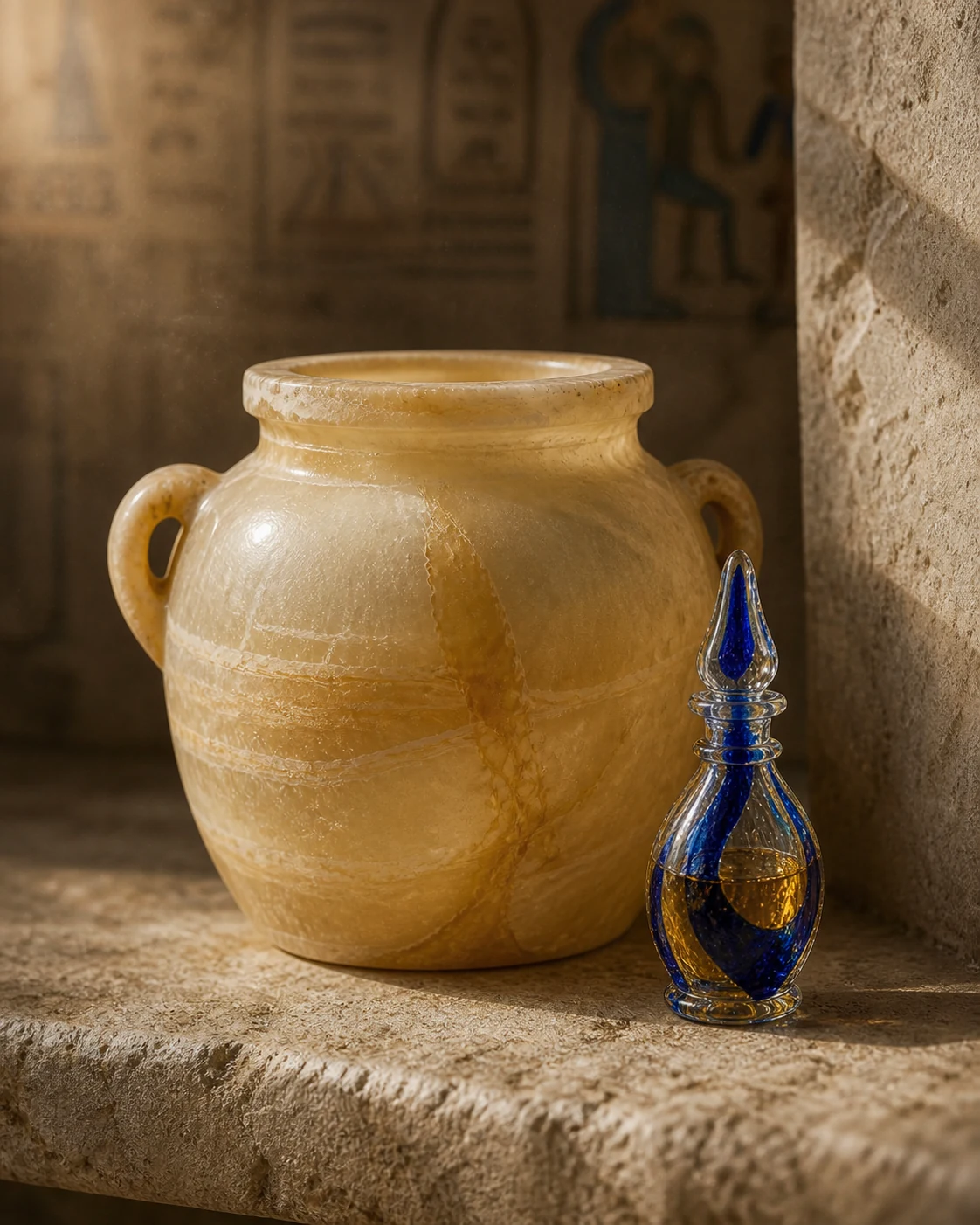
Perfume is never only the liquid. The vessel matters. Ancient Egypt understood that clearly.
Museums are full of Egyptian jars, cosmetic vessels, ointment containers and small stone forms that once held oils, unguents, eye paint or other precious materials. Some were simple. Some were luxury objects. Some were carved from travertine, often called Egyptian alabaster. Some were made from anhydrite, steatite, faience, glass, clay or wood. The material depended on period, purpose and wealth.
Alabaster has become the famous one because it looks almost alive. It can be creamy, honeyed, veined and translucent. Hold a thin piece to light and it seems to glow from inside. That quality suited perfume and ointment perfectly. A precious scent deserved a vessel that felt cool, heavy and permanent.
Why stone made sense
Oil and unguent are not handled like water. They are valuable. They are used in small amounts. They can stain, leak or spoil if treated carelessly. A stone vessel gives weight and protection. It also signals that the contents are not ordinary.
The Met has a Middle Kingdom ointment jar from around 2051 to 2000 BCE that was found with other cosmetic vessels in a wooden box. The museum describes it as a type likely used to hold perfumed oil or unguent. The Cleveland Museum of Art describes a Middle Kingdom cosmetic vessel as the kind that would have contained scented oils or ointments for beautifying the body.
These are not fantasies. They are object records. They show the material culture around scent: jars, boxes, lids, surfaces worn by use, and tomb contexts where care for the body continued into the afterlife.
The vessel as status
Most people in ancient Egypt did not live surrounded by carved luxury stone. A fine vessel spoke of access. It could belong to an elite household, a tomb assemblage, a temple, a court workshop or a person with enough means to own beautiful materials. That does not make scent only elite, but it does mean the best containers were status objects.
This is easy to understand now. A plain bottle can hold a good oil. A beautiful bottle changes the experience of keeping it, using it and giving it. The ancient version was the same in principle, only the materials and meanings were different.
Alabaster and the afterlife
Scent followed the Egyptian dead. Oils and unguents appear in funerary settings because the body, the tomb and the afterlife needed care. Perfume was connected to purity, preservation, pleasure and rebirth. A jar placed in a tomb was not only storage. It was part of an equipment set for continued existence.
This is why ancient perfume vessels often feel more serious than modern packaging. They sit between daily life and ritual life. A cosmetic jar could be used in life, then placed in a tomb. A container could show wear from use, then become part of burial.
What it means for modern oil
Modern perfume oil does not need alabaster to be good. But the lesson remains useful: the vessel should respect the material inside.
Perfume oil is slow. It is touched, not sprayed. It is used drop by drop. A good container should make that clear. It should help you dose the oil carefully. It should protect the contents from light and mess. It should feel like something worth keeping.
That is why small hand-blown bottles and simple apothecary bottles both make sense. One treats the bottle as a piece of craft. The other keeps attention on the oil. Both are closer to the ancient logic than a disposable plastic mist.
The old Egyptian lesson is direct: if the scent is precious, the thing that holds it should not be an afterthought.